Activity and sleep
To view your activity in the charts, make sure to Synchronize data first. Then tap the Charts icon on the home screen to access activity charts. Tapping one of the daily statistics on the home screen will bring you directly to the relevant chart.
Charts
Here is a list of charts and their explanations that Gadgetbridge provides for your gadget.
Available charts may vary to the gadget
Because each gadget can provide different types of data, the graphs you see on the activities screen may vary. Also, if you're using a gadget that doesn't have capability to track activities (non-wearable devices, such as headphones), you won't be able to see any of these charts.
Overview
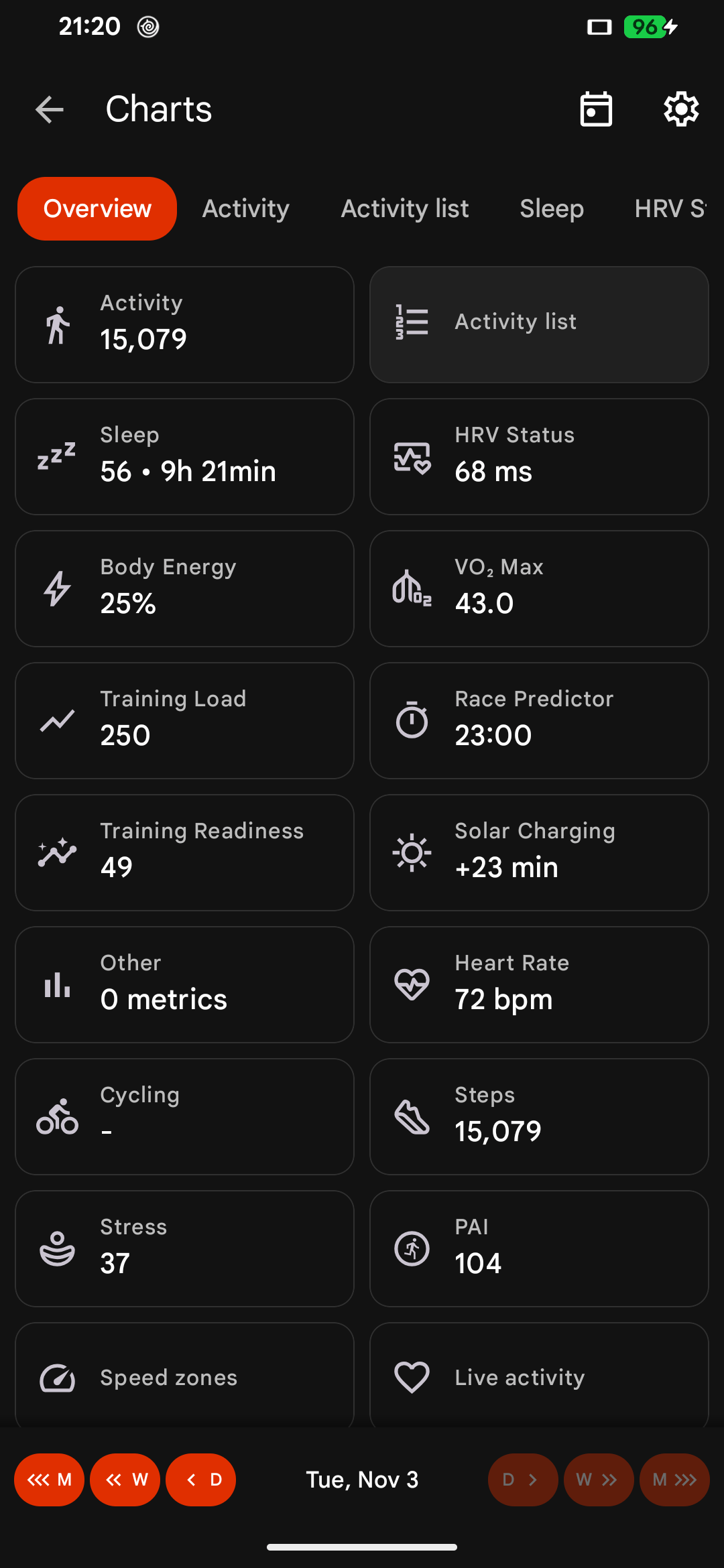
This tab displays all the enabled charts for the device, as a list of tiles. Each tile contains the value for the selected day. Tap a tile to jump to its chart.
This tab is only available when the device supports more than 3 charts.
Activity summary

This tab displays activity intensity (movement) on Y axis (green during the day, blue during night), heart rate on Y axis (orange), time on X axis.
Activity list

This tab in charts allows observing and analyzing your movement/activity sessions throughout the day without having to turn on activity tracking feature on the gadget.
Make sure to adjust your personal settings and goals, available in the global settings menu under "Settings → About you" and from the current screen top right button Settings → About you.

You can also change how activities are being detected, via Settings icon on top-right (while viewing charts), then scrolling down to "Activity list". Here are the determining factors:
- Activity session is detected by steps per minute or by activity intensity. The minimum steps per minute required for an activity to be detected as activity session can be set in "Minimal steps per minute to detect activity".
- Activity session must be at least X minutes long, this minimal duration can be set in "Minimal activity length".
- Activity session ends with a pause longer then a given interval, it can be set in "Pause length to split activities".
- Activity session is marked as "Running" if steps/m > 120, this can be set in "Minimal steps per minute to detect run".
- Activity session is marked as "Exercise" if it has less the 200 steps but has
heartRateAverage> 90 andintensity> 15.
To know how it is calculated behind the scenes, you can check out the StepAnalysis source code.
Sleep

This tab shows sleep information just for the past night.
You can adjust the view interval to "Noon to noon" or "Past 24 hours". The circular chart shows light/deep sleep break down. Do note that for most watches, the deep sleep detection is not reliable. But, what you mostly care about is heart rate, often this can be enabled as "Continuous HR measurement" or "Improve sleep detection by using HR" in settings.
Minimum/maximum and average heart rate is displayed in the heart icon. Also, movement intensity (the blue lines on Y axis) is displayed as total for the night in the intensity icon.
Deep-sleep detection
The following devices are known to sync sleep stages, including deep sleep:
- Zepp OS 3.5 devices and above (eg. Amazfit GTR 4, Active 2)
- On older Zepp OS watches, sleep stage and sleep times are not accurate
- Garmin watches that display sleep stages without a phone connection
- On older Garmin watches that only send raw sleep data (for example the original Instinct), Gadgetbridge estimates the sleep stages from movement and heart rate pull request #7061
- Huawei watches without TruSleep
- Nothing CMF watches
- Some xiaomi-protobuf watches, but not all (eg. Mi Band 8)
There is no good Deep Sleep detection on old Huami (e.g. Xiaomi and Amazfit) gadgets. This is an issue currently in old Huami gadgets, with the exception of VERY EARLY factory versions of the Amazfit Bip and older Mi Band 2 firmwares. issue #232
The reason is that the gadgets no longer properly distinguish between light and deep sleep but set some flags or hints for later analysis which is probably done in the Mi Fit app. The presumption is, that the Mi Fit app does some post processing on the data. Some work to analyze this has already been done, but no implementation has landed in Gadgetbridge. We would welcome a contribution in this direction.
So at the moment, we ignore these flags and hints completely, because despite of some theories and discussion, it is still unclear how all this works. This information still lands in the database, so if we fix the analysis one day it will retroactively work.
Having said that, the "Use heart rate sensor to improve sleep detection" works and you get good view into your heart rate during sleep.
Steps

The Steps overview shows a graph with the detected steps per day. The X axis can display a week or a month, depending on what you have set in Settings → Charts Range.
On this screen you can tap on the Trophy icon to see your step streaks.

Steps streaks screen shows ongoing (if present), longest steps streak (series of days without interruption with the daily step goal reached) and also total statistics of daily goals success rate. You can use long press on some text elements to read more details, for example the total steps per day average.
By tapping the Share icon you can export and share an image with these statistics.
Stress

The stress screen provides with an overview of the stress levels during the day, as well as the average stress and breakdown of time for each stress level.
Training Load
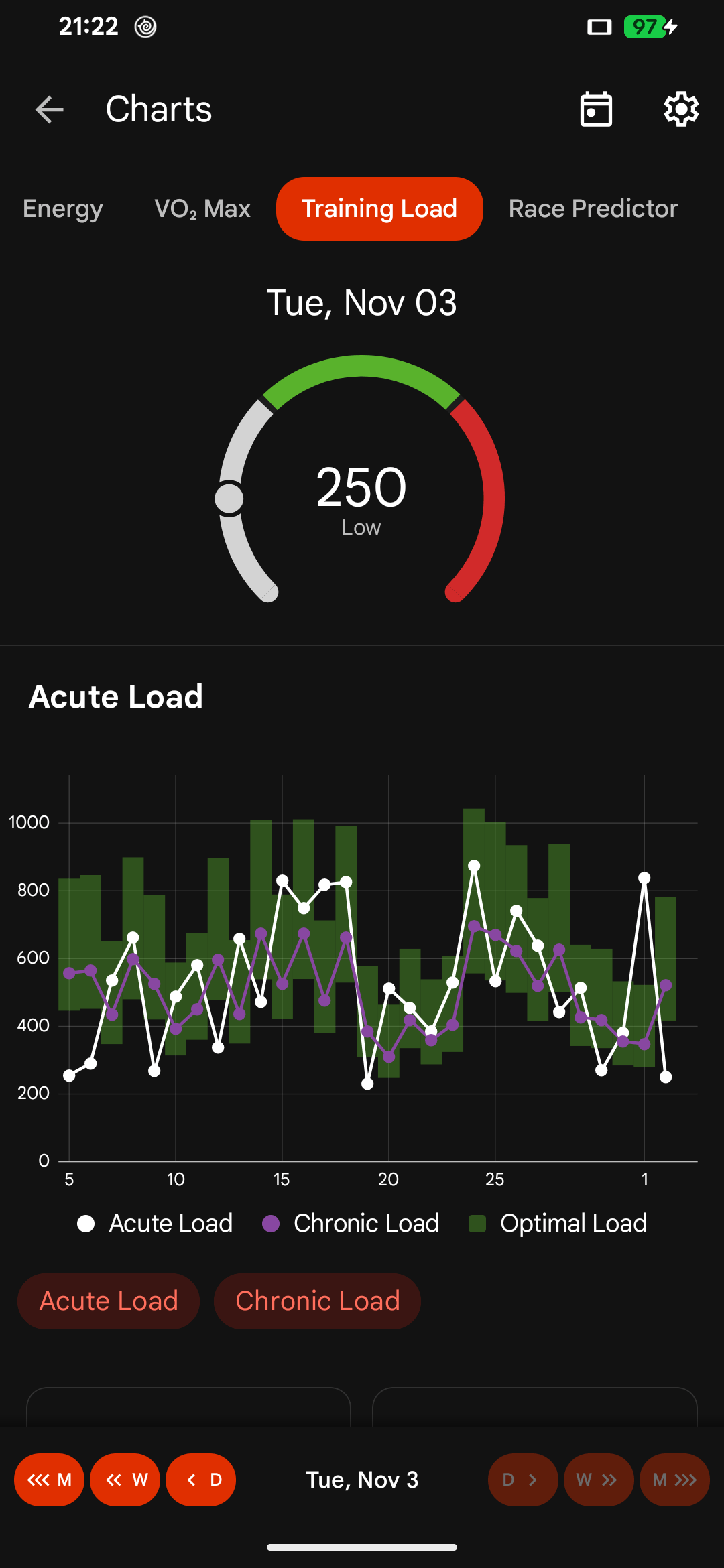
Available for gadgets that report a training load, such as Garmin and Xiaomi watches.
The chart shows the Daily Load of your workouts, the Acute Load (short-term) and, when the gadget reports it, the Chronic Load (long-term), with the Optimal Load range in the background. Chips let you show or hide the acute and chronic load lines. pull request #6564
The status gauge shows whether your load is Low, Optimal, High or Very High. pull request #6464
Heart Rate
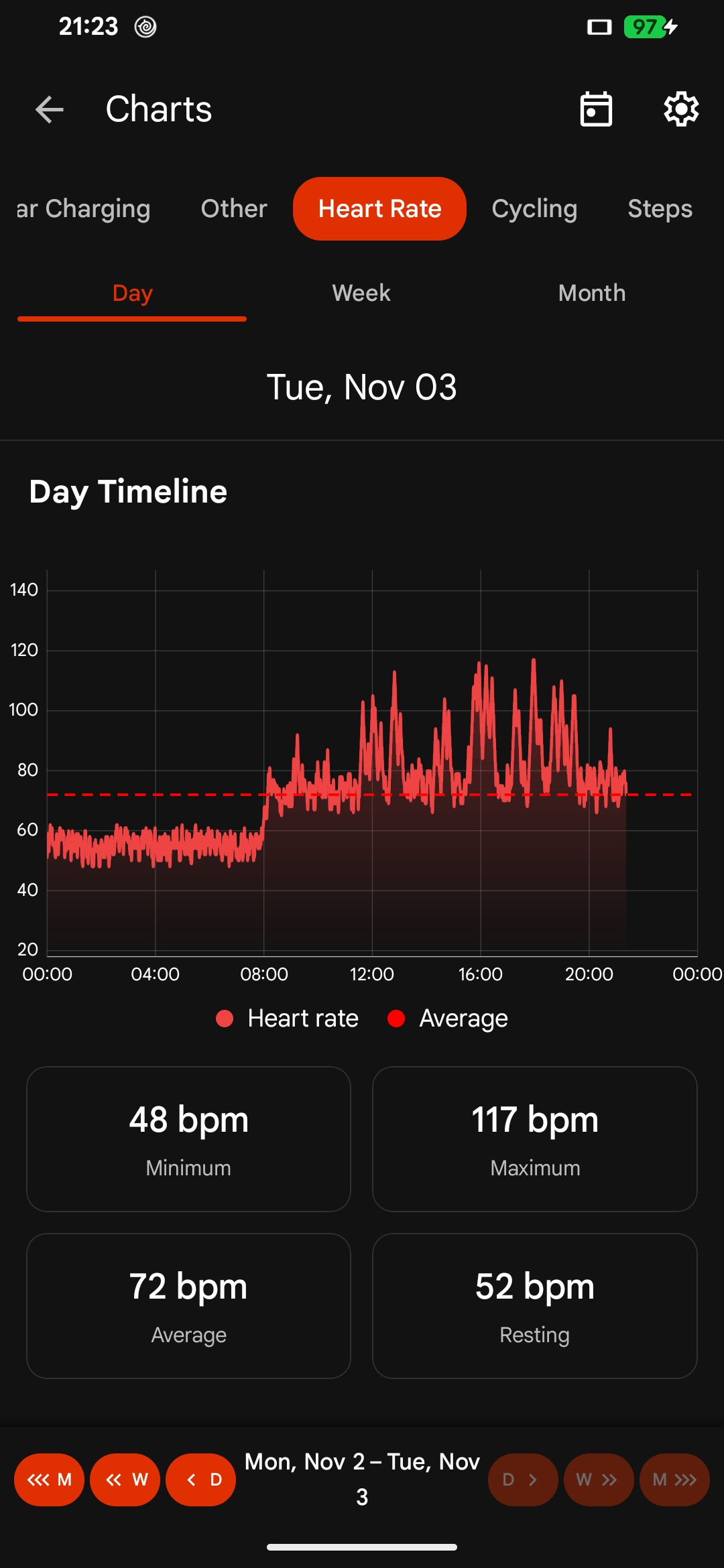
This tab shows the heart rate over time, with the minimum, maximum, average and resting values. It is also possible to see the trend for week / month periods.
HRV Status
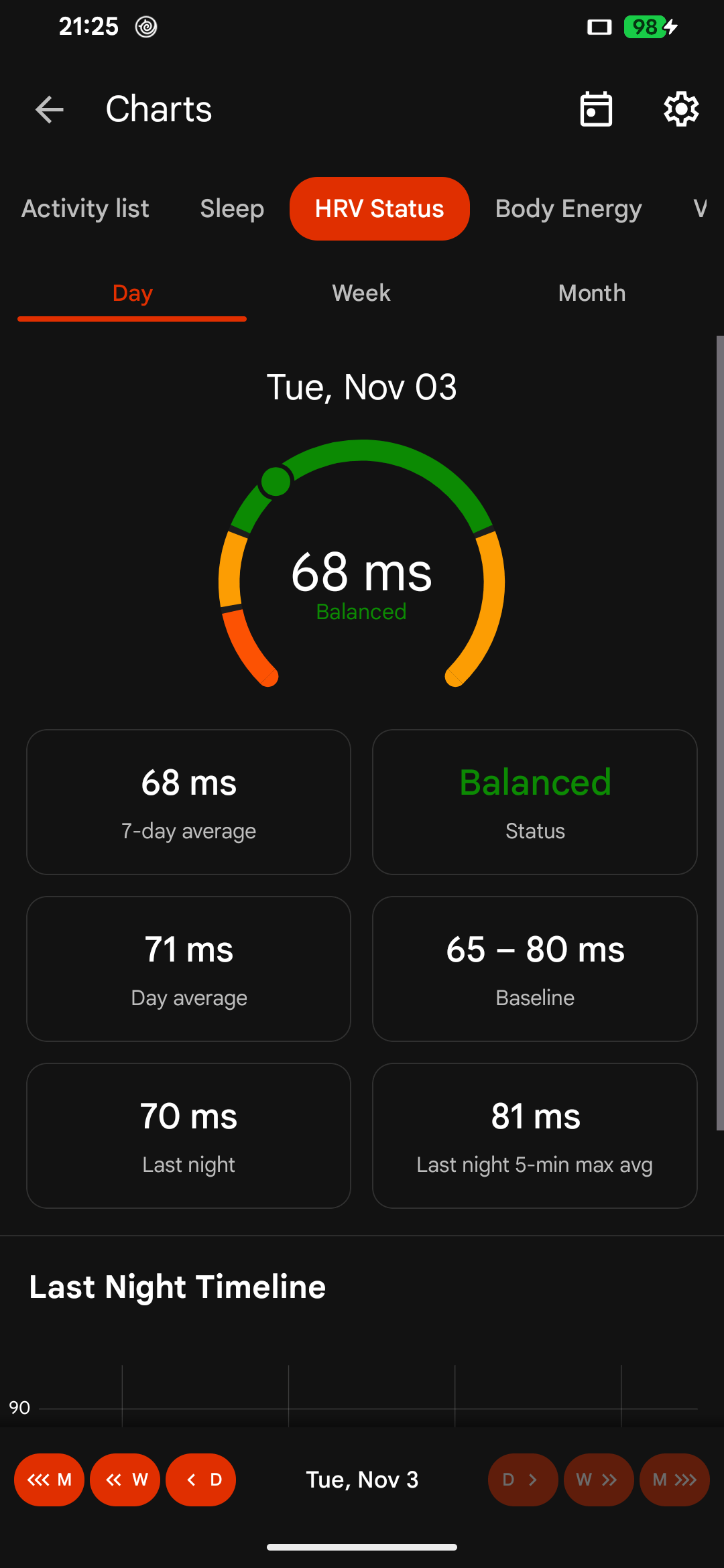
This tab shows the heart rate variability (HRV) timeline of the last night, and the HRV trend. It also shows the nightly average, the 7-day average, the baseline and the status: Balanced, Unbalanced, Low or Poor.
For devices that report the summary, the value reported by the device is used (Garmin). For other devices, Gadgetbridge computes the values from the per-minute HRV samples.
Body Energy
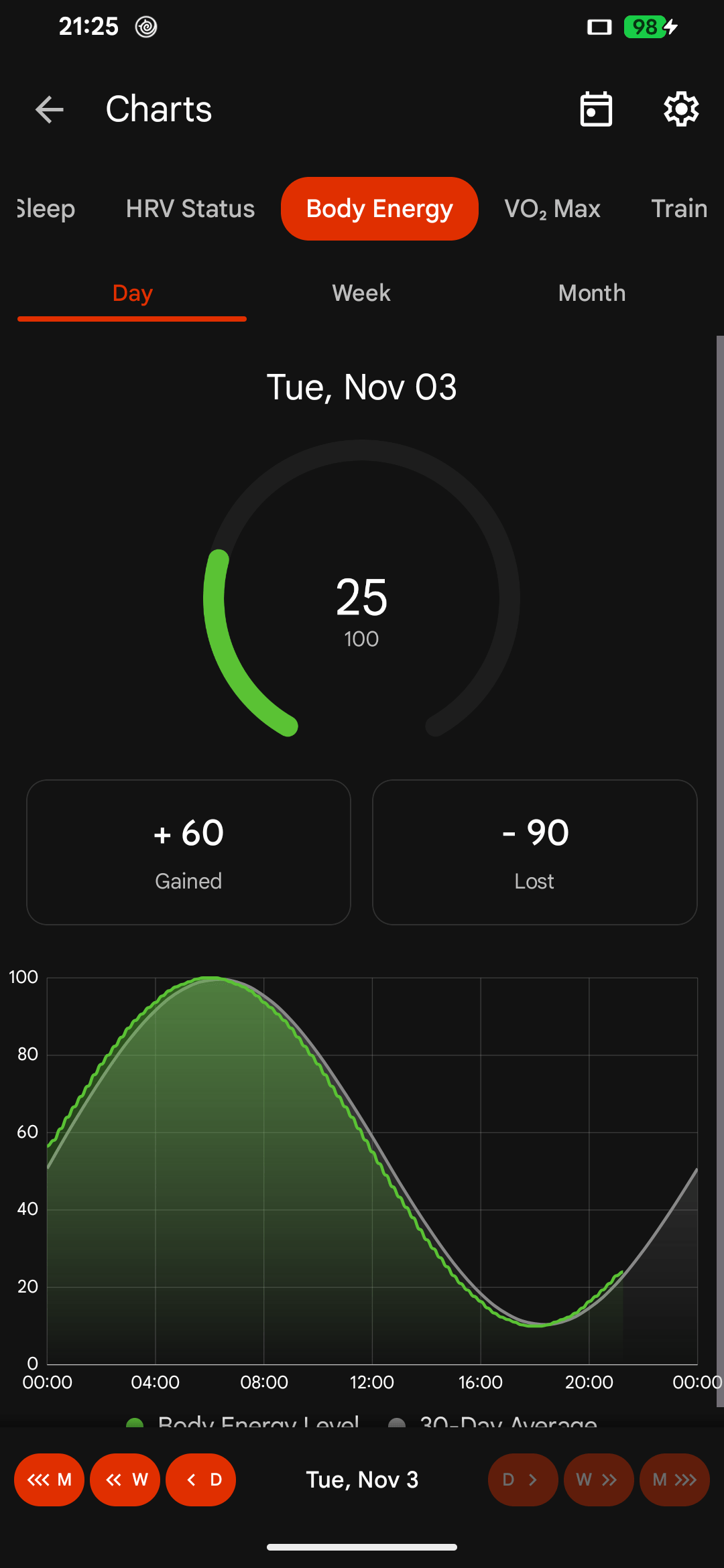
This tab shows the "body energy" level over time, with the energy gained and lost.
This feature has different names on some devices (e.g. Body Battery in Garmin).
VO₂ Max
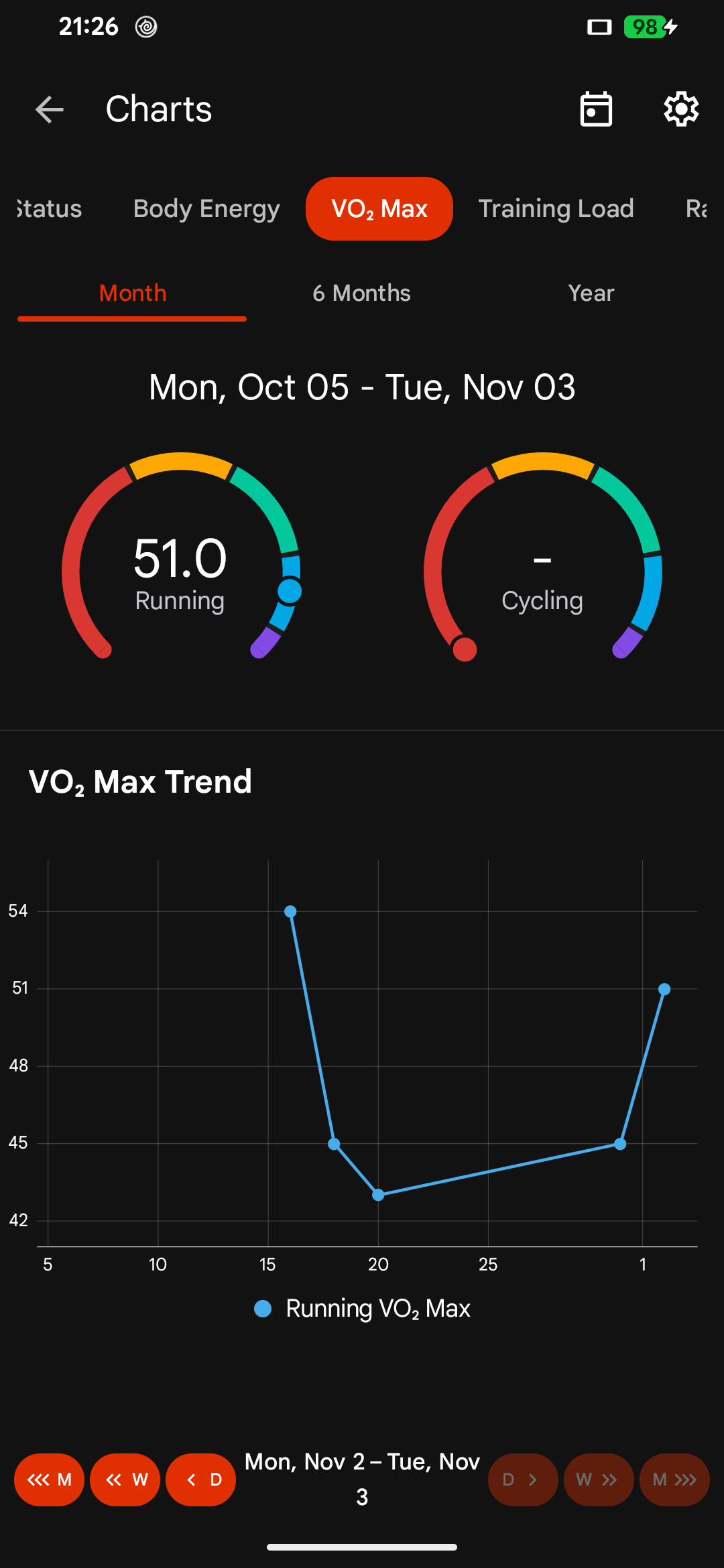
This tab shows VO₂ Max trend for the month / 6 months / year. For devices that report different values for running and cycling, they are both displayed.
Race Predictor
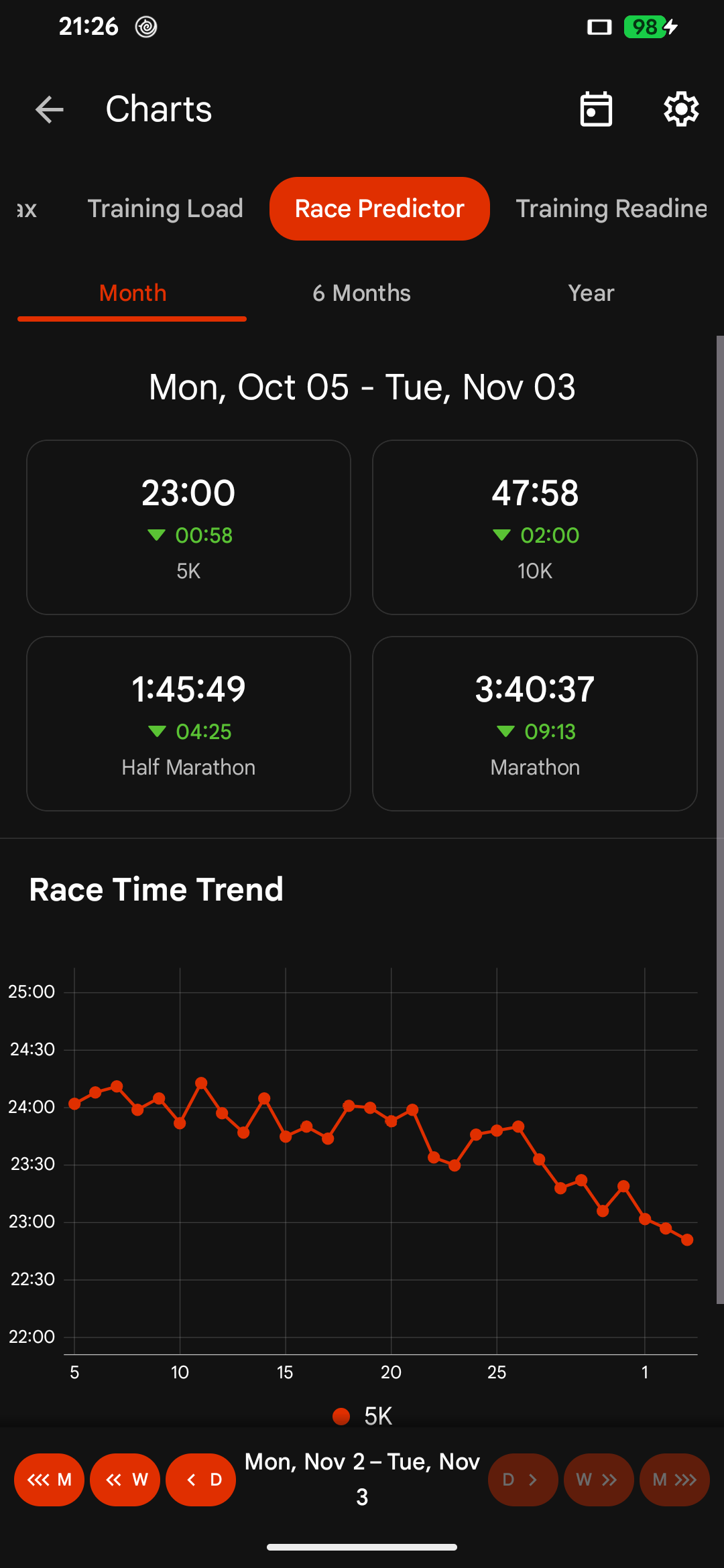
This tab shows the race times predicted by the watch, and their trend.
Training Readiness
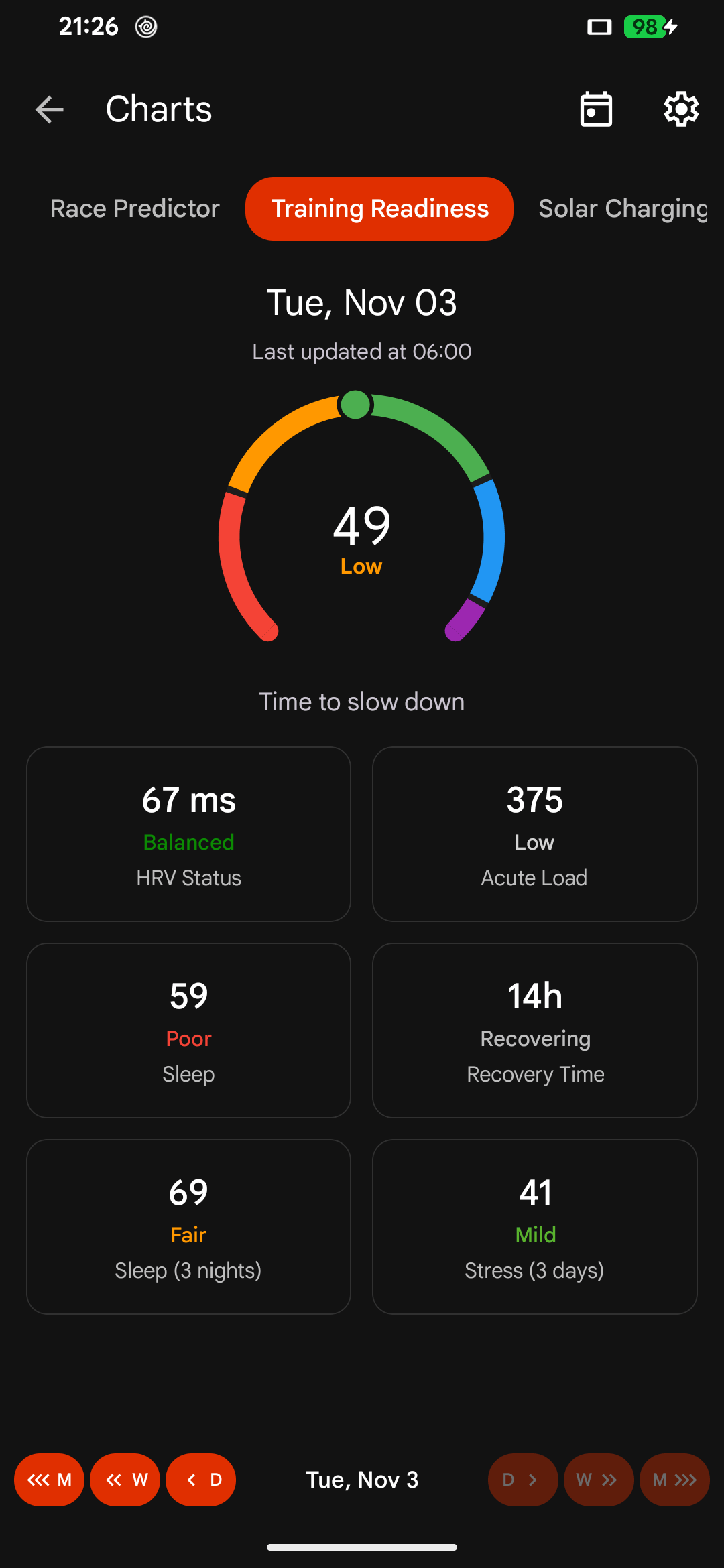
This tab shows the training readiness reported by the watch, along with the factors that affect it: sleep, recovery time, acute training load, HRV status, and stress.
Solar Charging
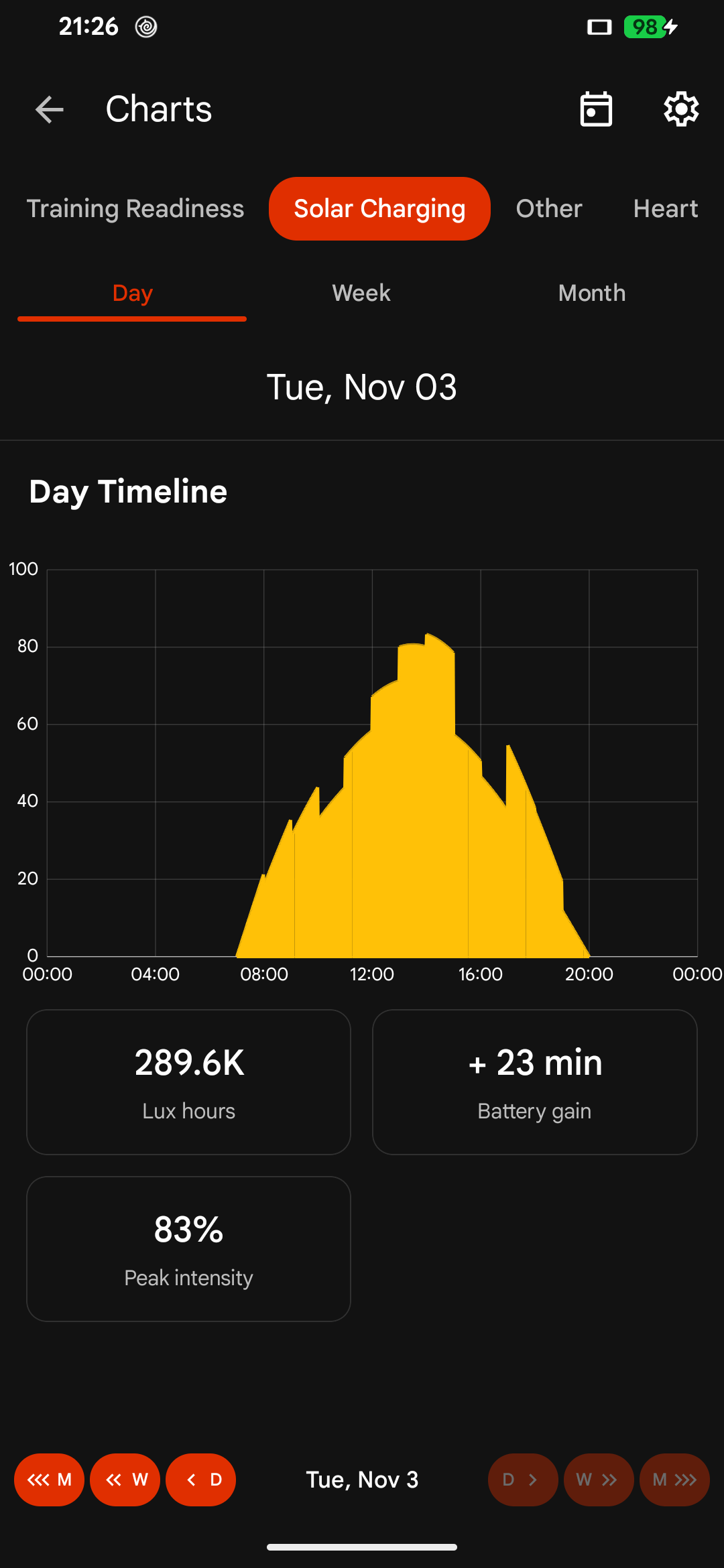
This tab shows the solar charging intensity, with the lux hours, the battery gain, and the peak solar intensity.
PAI / Intensity Minutes / Vitality Score
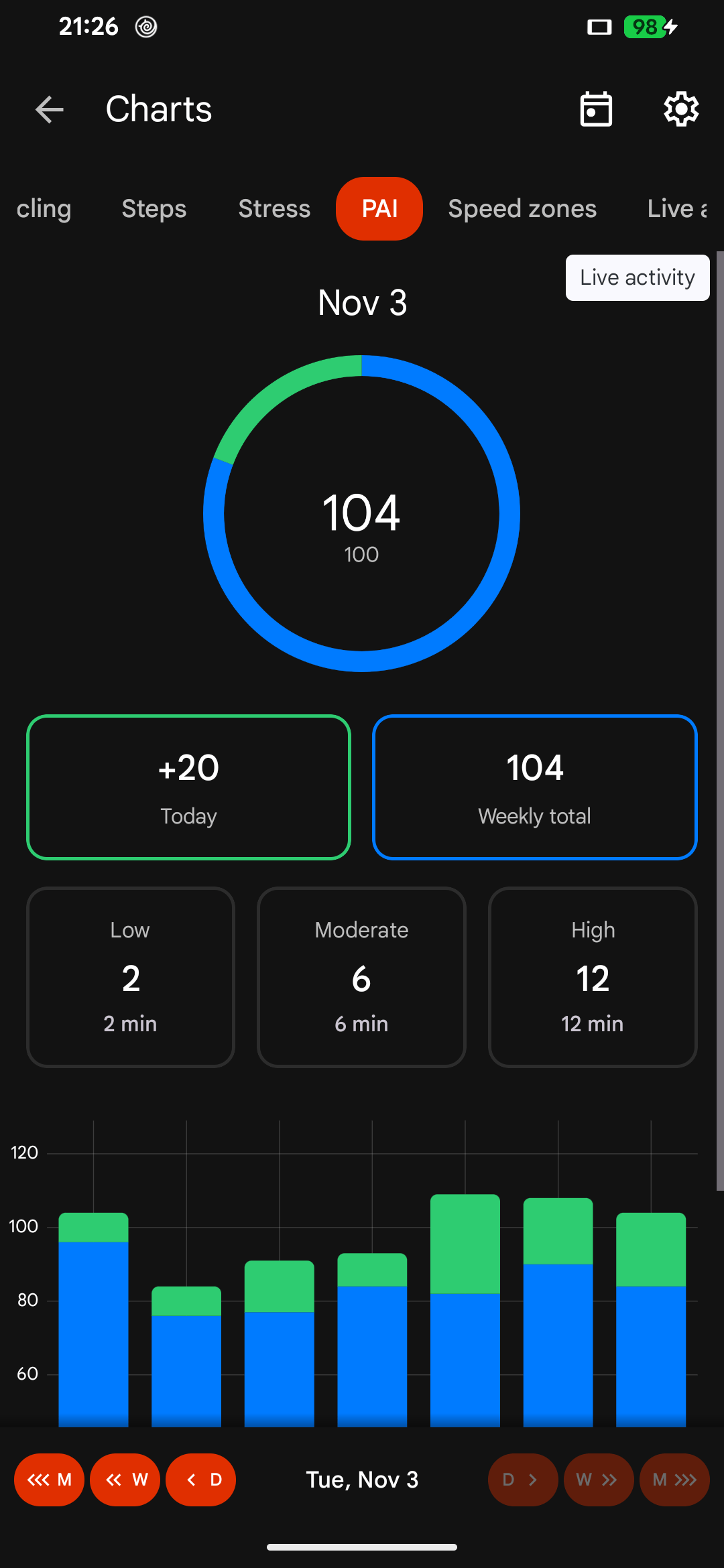
This tab shows the Personal Activity Intelligence (PAI) score per week or month, and the time in low, moderate and high activity zones.
The name of this feature changes depending on the gadget brand:
- Huami (Amazfit / older Xiaomi): PAI
- Garmin: Intensity Minutes
- Xiaomi: Vitality Score
Speed zones
This tab shows the total minutes spent at specific cadences.
Live activity
This tab shows real-time data from the connected gadget: the current and maximum heart rate, the current cadence in steps per minute, and the total steps.
Blood Oxygen
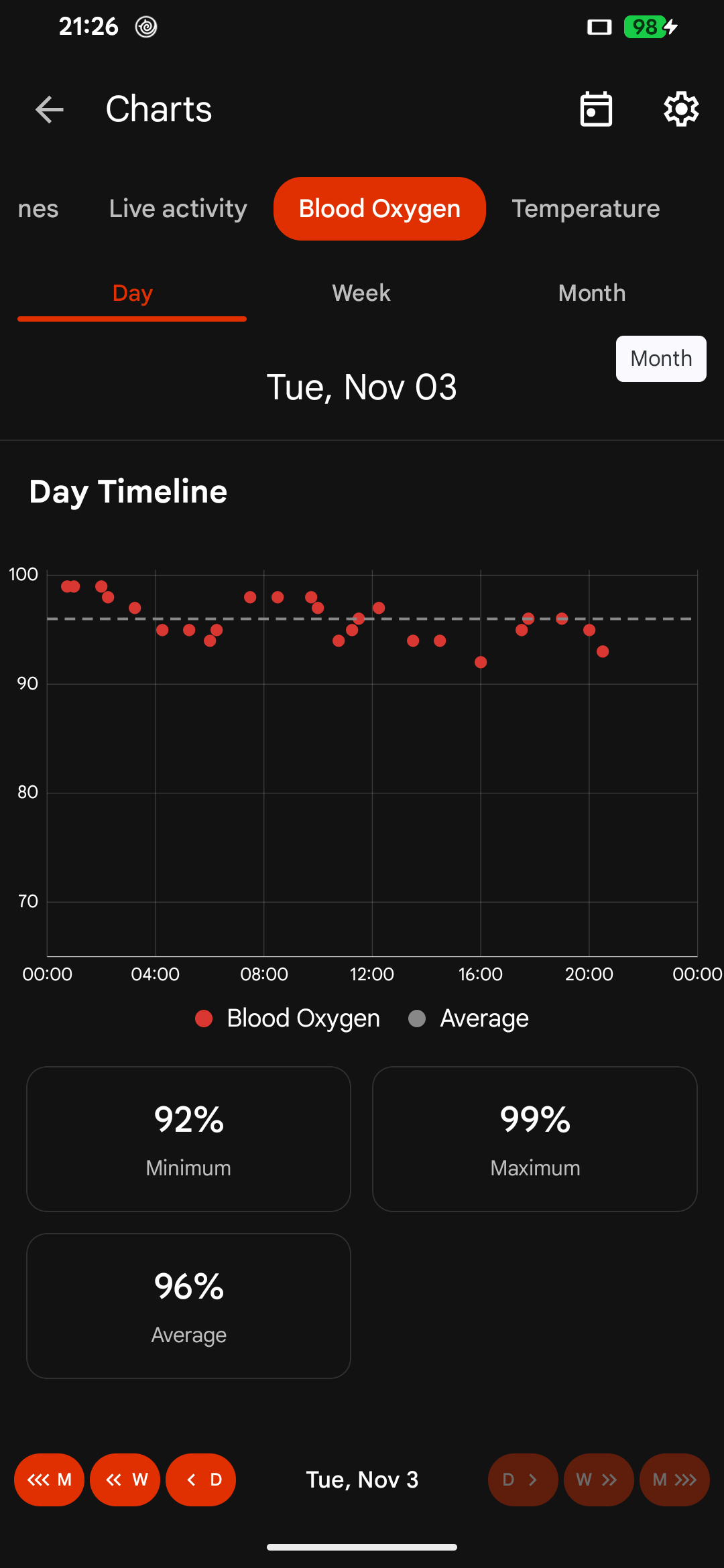
This tab shows the blood oxygen (SpO₂) level over time, with the minimum, maximum and average. It is also possible to see the weekly and monthly ranges.
Temperature
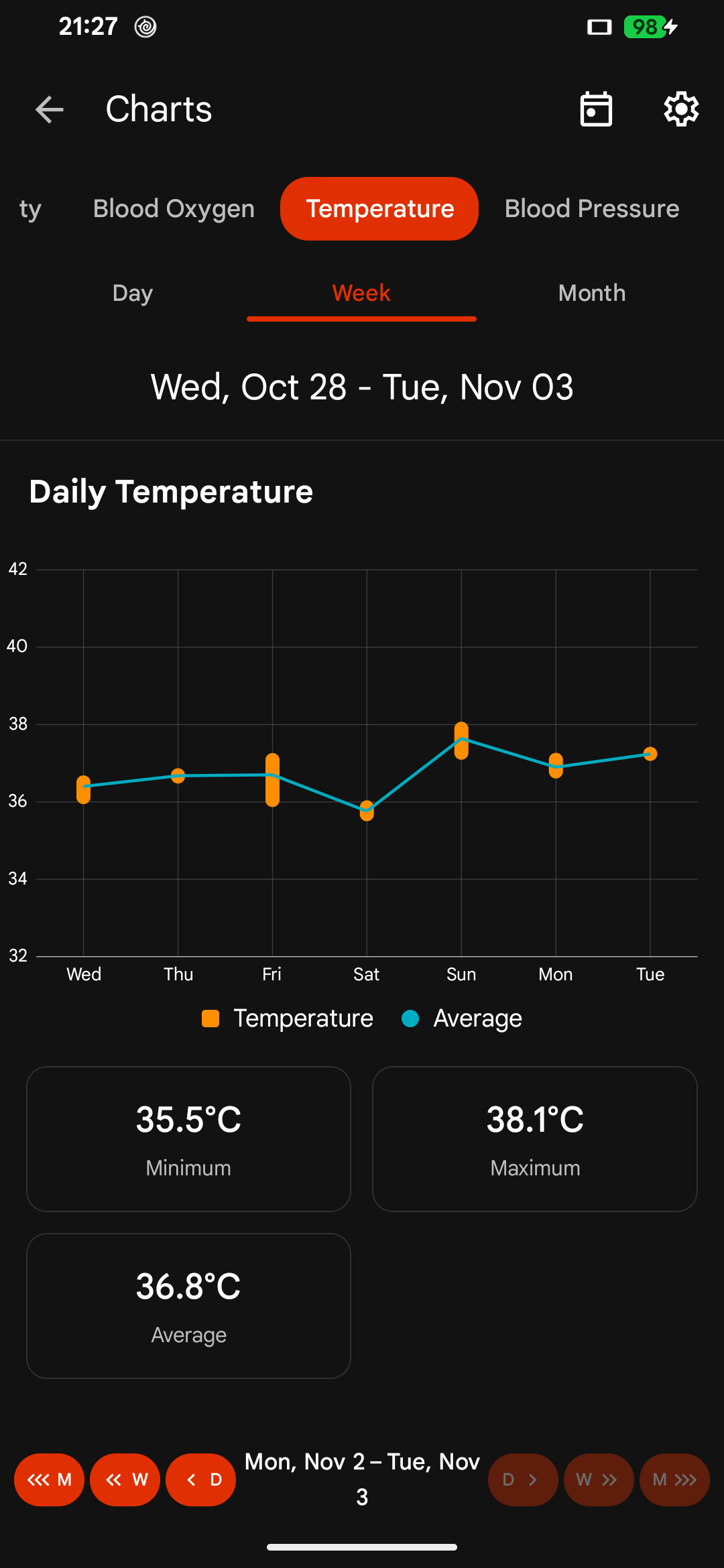
This tab shows the temperature over time, with the minimum, maximum and average.
In the weekly and monthly view, it is possible to see the ranges for each day.
ECG
Not yet released
Support for this feature has been added to Gadgetbridge's codebase, but is not yet released. It is already available in the nightly releases.
This tab shows the list of the electrocardiogram (ECG) records recorded by the device, with the average heart rate and the duration.
Clicking a record allows you to see the waveform, the classification that the gadget reports, and the sample rate.
It is possible to share the record as CSV by clicking the Share icon.
Not for medical use
The ECG data may be wrong or incomplete, and the interpretation may be different from the manufacturer's app. This is intended for informational use only. Do not use this data to take any medical action. If you do not feel well, contact a medical professional. For chest pain, fainting or acute shortness of breath, call emergency services immediately.
Blood Pressure
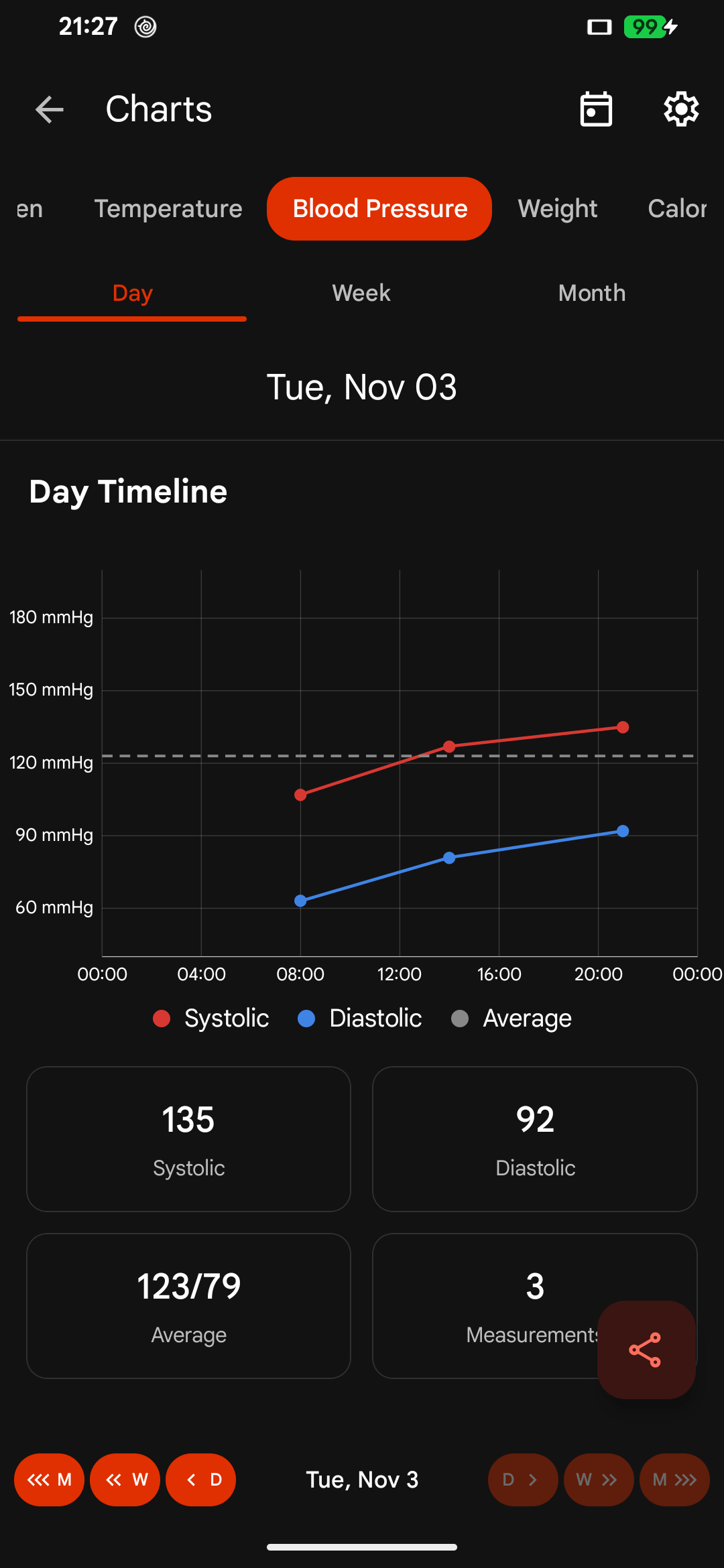
This tab shows the blood pressure measurements, as well as the pulse rate during those measurements. The individual measurements are listed.
It is possible to share the data as CSV or PDF by clicking the Share icon.
Weight
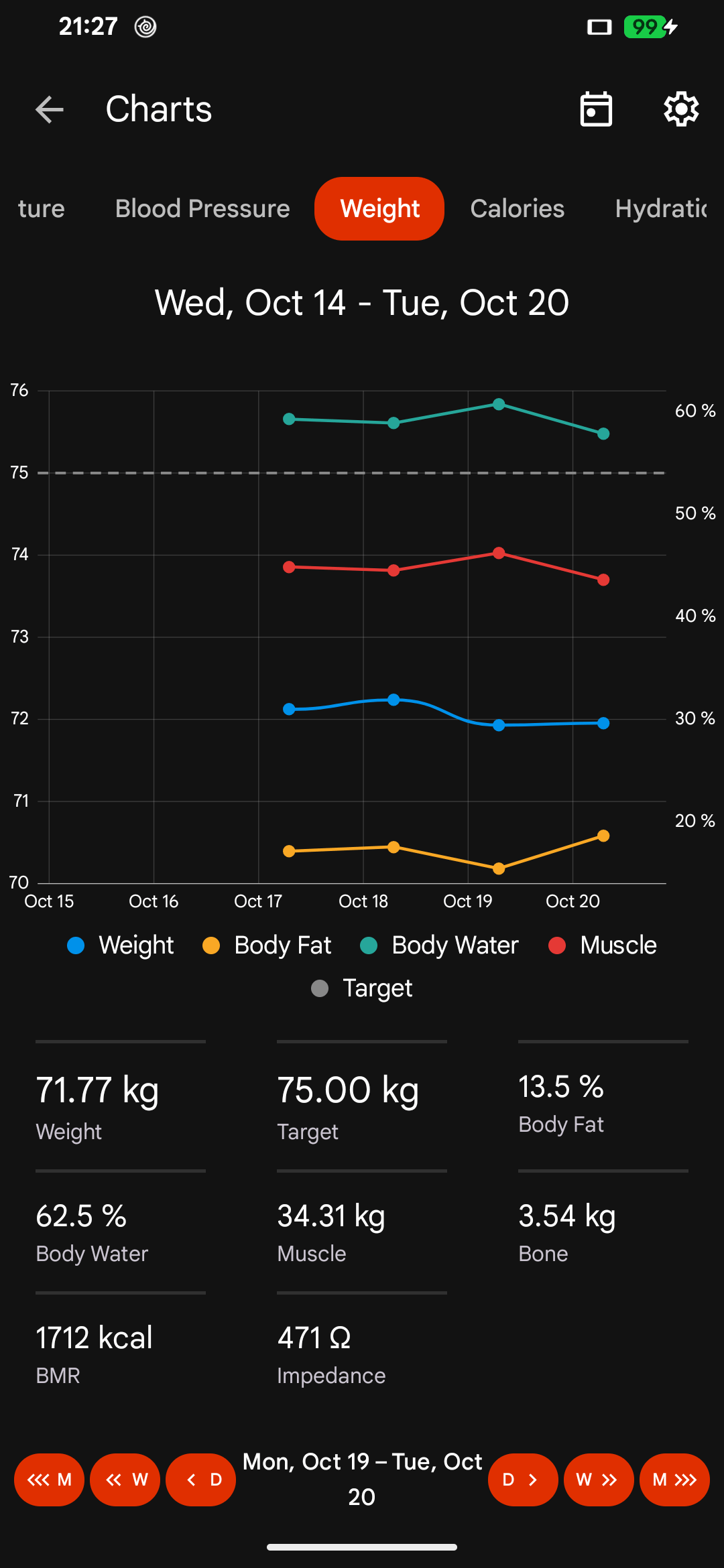
This tab shows the weight over time, and the weight target.
If the scale reports impedance, it also shows its value, along with the computed body mass index (BMI), body fat, body water, muscle, bone, and basal metabolic rate (BMR).
Altitude
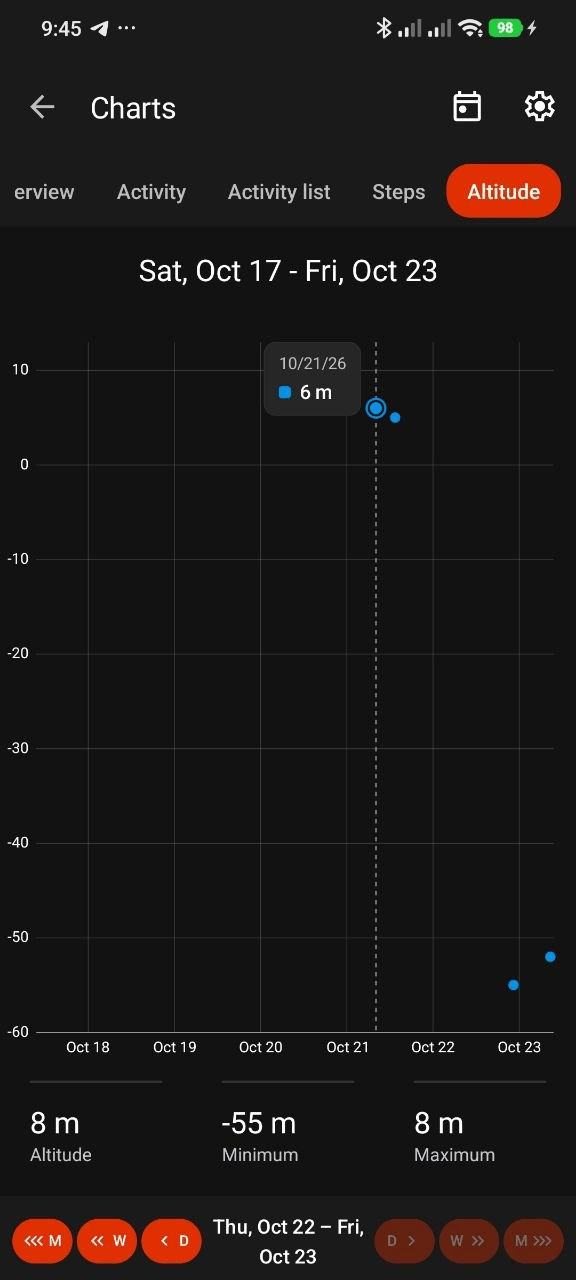
This tab shows the altitude measurements reported by the watch, with the minimum and maximum.
Calories
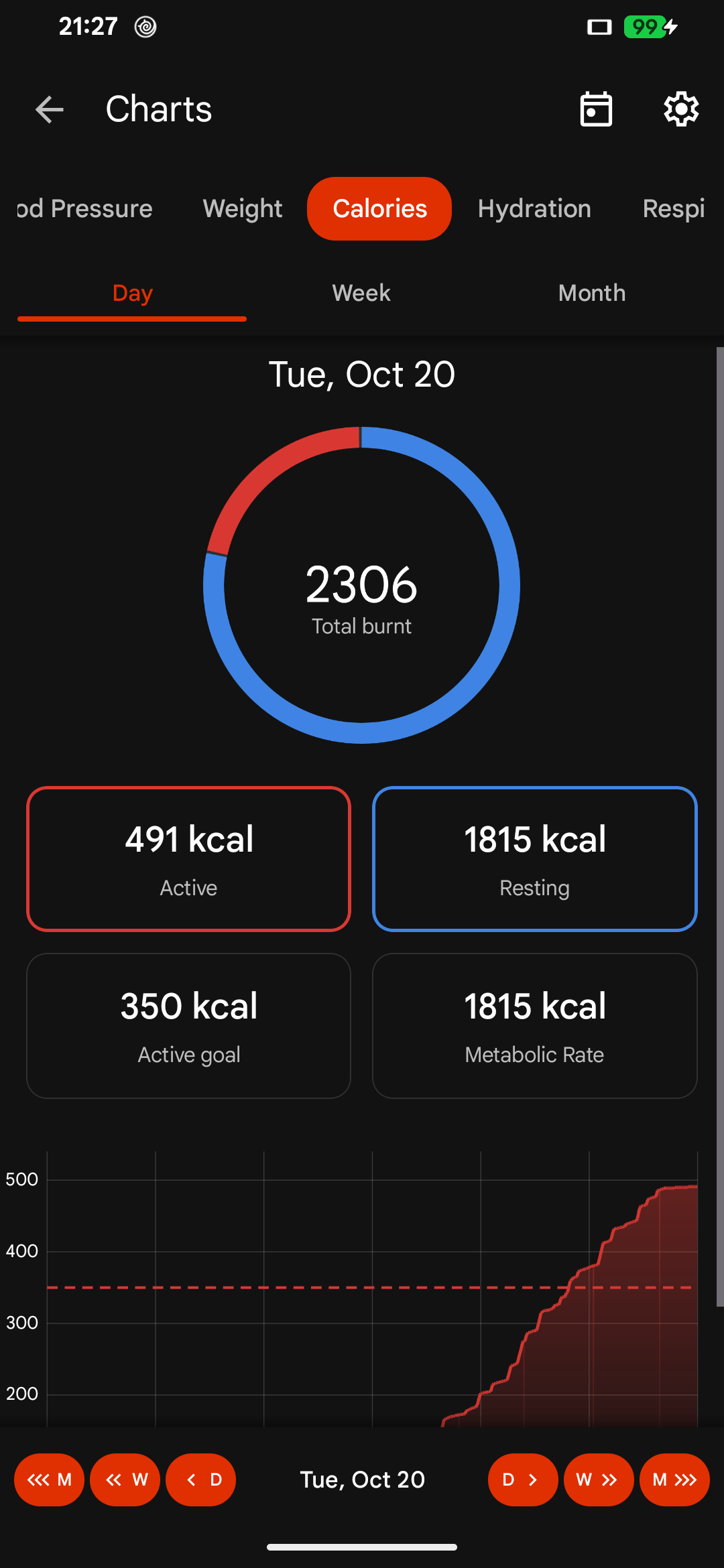
This tab shows the active and resting calories, the total calories burnt, and the active calories goal.
Hydration
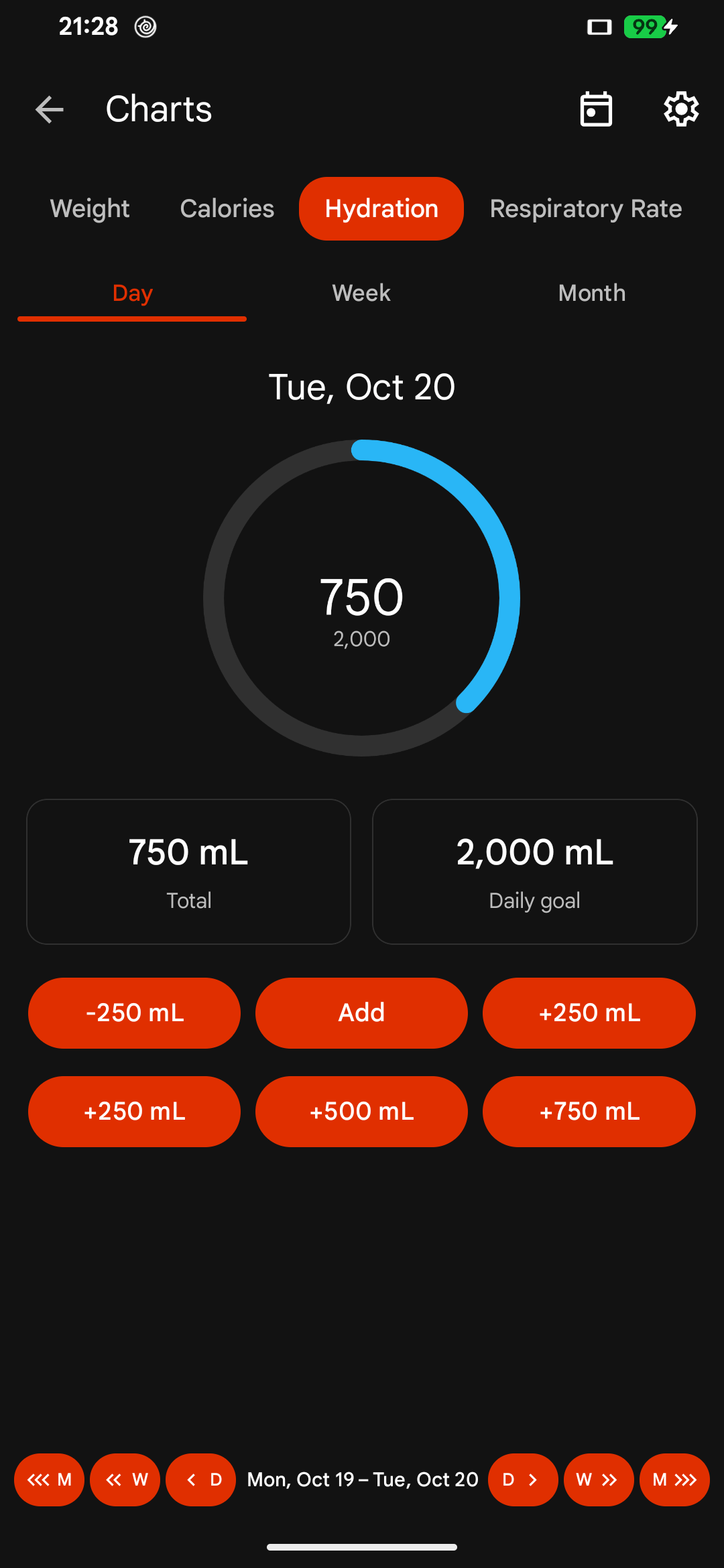
This tab shows the logged water intake, and the daily goal.
Use the Add button to add water intake. It is possible to configure the container sizes.
The week and month tabs show the daily water intake for the corresponding periods.
Respiratory Rate
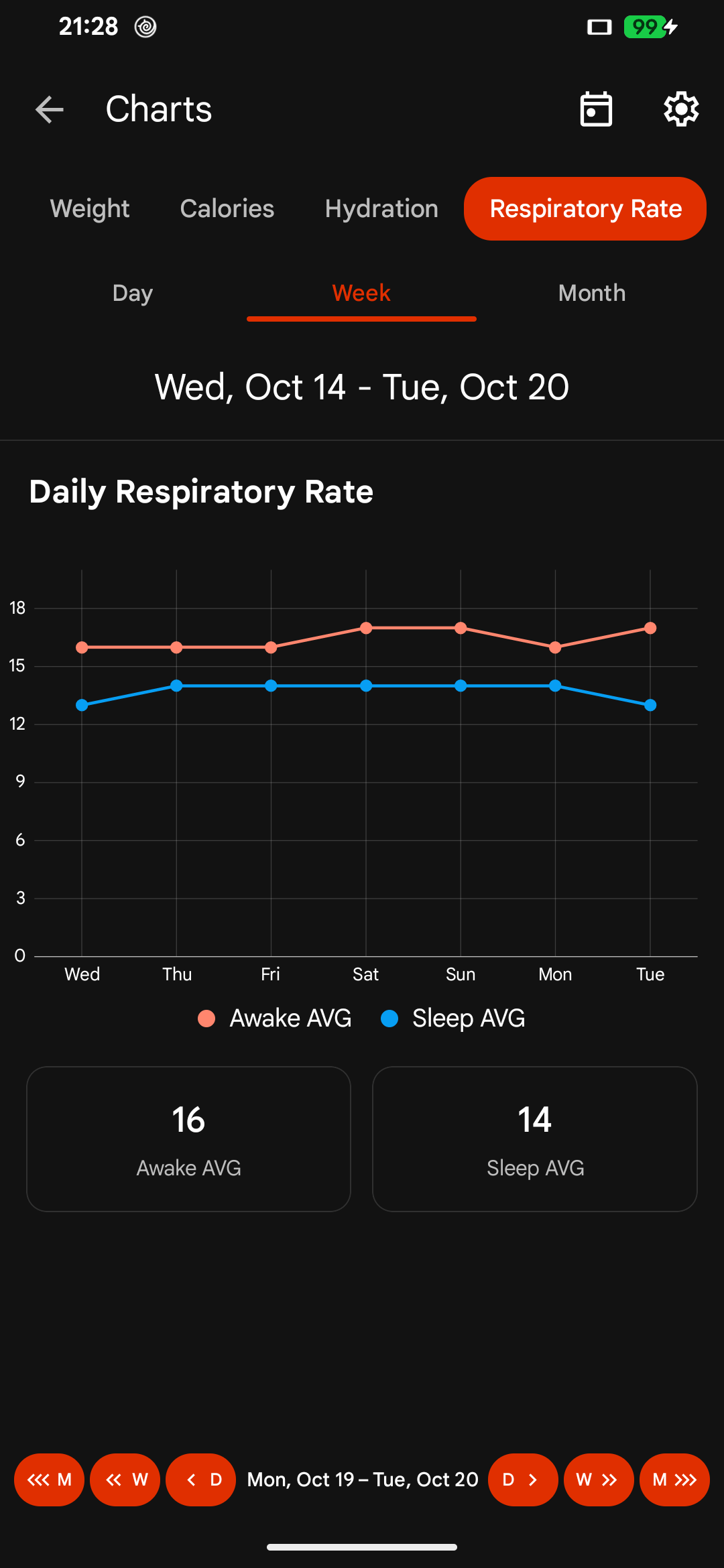
This tab shows the respiratory rate over time, split between awake and sleep periods, if the watch reports them.
Cycling
This tab shows the cycling distance and speed from gadgets that report them, such as a cycling sensor.
Other
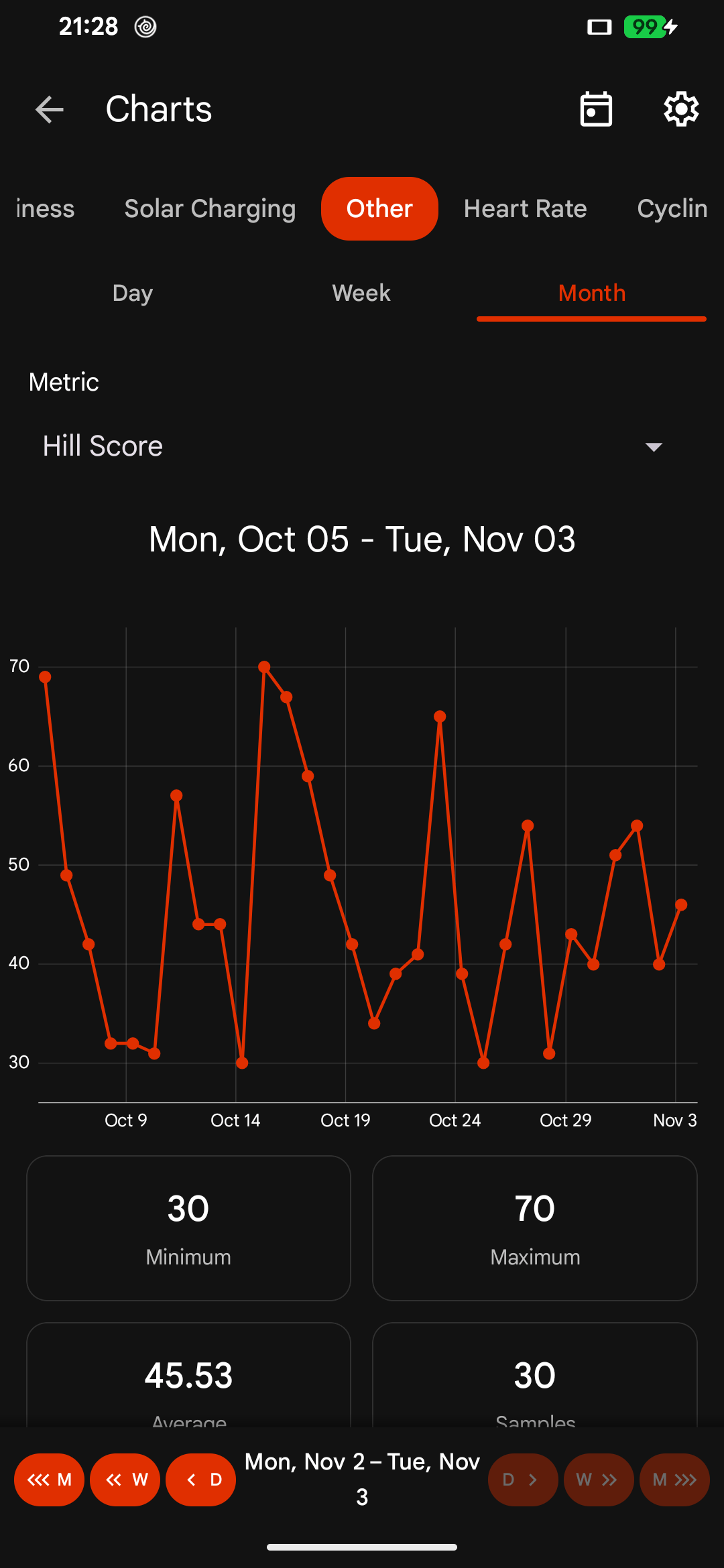
This tab shows other generic metrics that the gadget reports. Select a metric from the dropdown to display it over time, with the minimum, maximum, average, and the number of samples.
Intensity of an activity
One of the items in the activity list but also in the sleep chart is intensity which is indicated with a Fire icon.
It is an interesting value which typically does not surface as a number, but in fact it has been used throughout Gadgetbridge charts a lot: the green spikes on axis Y in activity charts? Intensity. The light and dark blue spikes on axis Y in your sleep charts? Also intensity.
It is a value (normalized to decimal between 0 and 1) that is representing a strength or an intensity of your activity, as determined by the bracelet. At night, the more you move, the higher this intensity is. During an activity or walk, the more your arm moves, the number seems to go up. So it seems good to expose this number even more, to be able to observe it, typically labeling it as "Movement intensity". The displayed result is not calculated as an average but rather as a total sum of the intensity of a particular activity in activity list or in your sleep. Hopefully you'll find it useful.

Setting up
You can change the visibility of activity charts and reorder them as you wish for each device paired to Gadgetbridge.
By disabling charts tabs that aren't interesting to you or aren't supported by your device, you can clean up the interface a bit by making it show only relevant information.
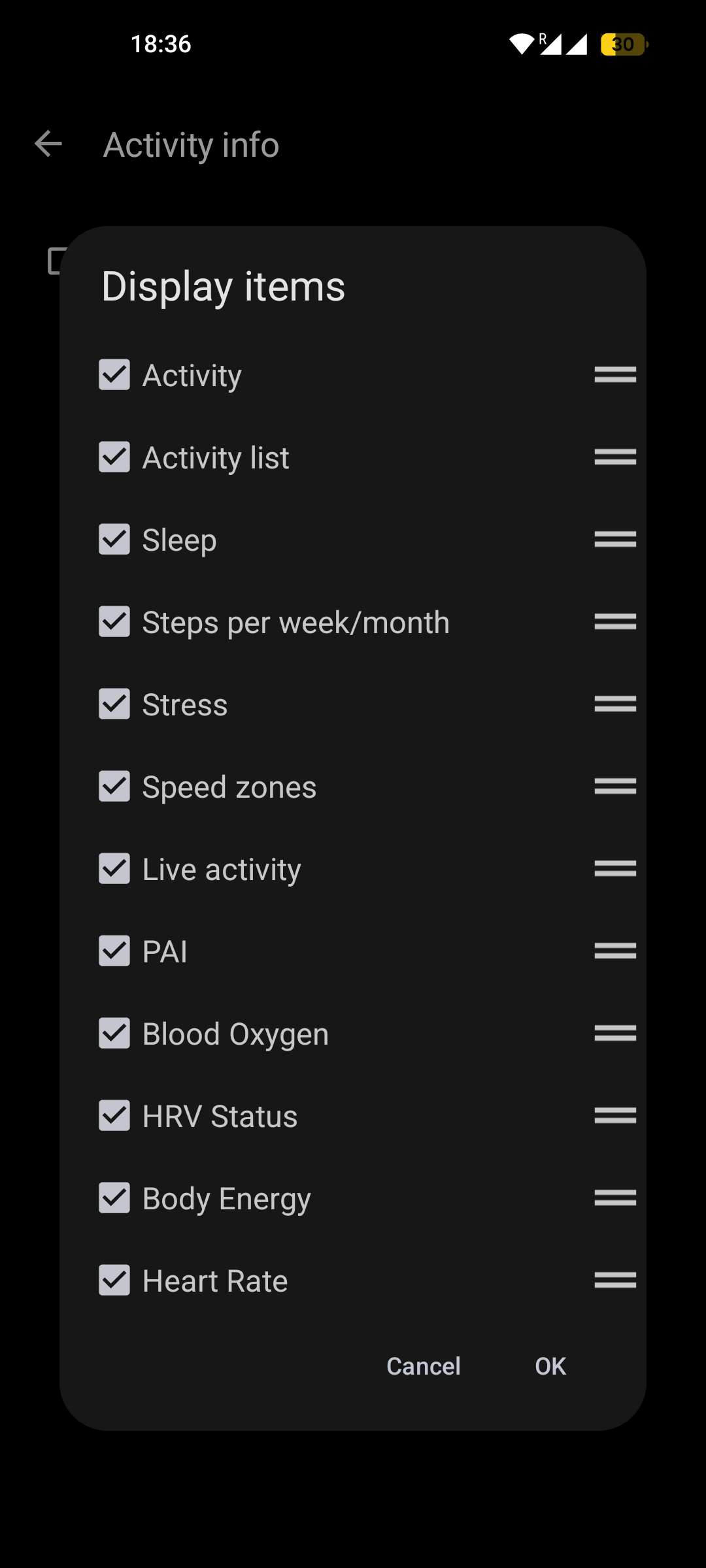
While on Charts screen, find Settings icon on top-right and click on Charts tabs.
Alternatively, on device specific settings, going to Activity info → Charts tabs will also take you to the same setting.
From there you can reorder (by dragging items) and set visibility (by checking the checkbox) of chart tabs.
When done, click "OK" to save.